CircuitBreaker
pattern
Monitors call outcomes and opens the circuit when failure or slow-call rates exceed configured thresholds — preventing calls to a degraded downstream service from propagating load.
01
State machine
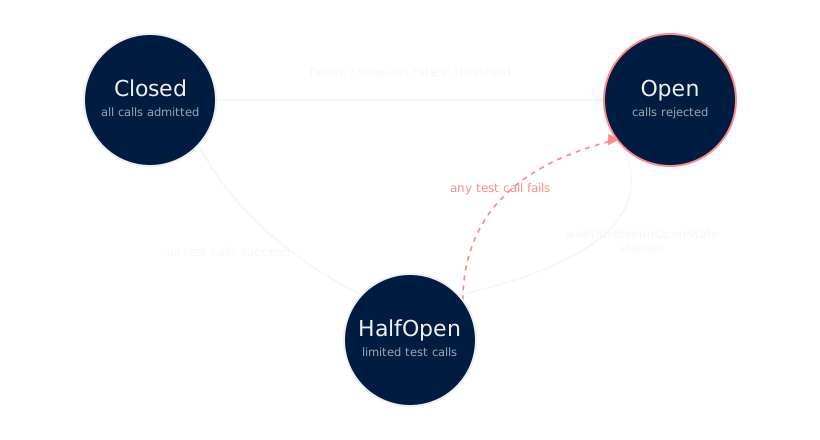
- Closed → Open — failure rate or slow-call rate exceeds its threshold, evaluated once the sliding window is full.
- Open → HalfOpen — after
waitDurationInOpenStateelapses. - HalfOpen → Closed — all permitted test calls succeed.
- HalfOpen → Open — any permitted test call fails.
02
Behavior
The CircuitBreaker maintains a sliding window of the last N call outcomes. After each call it recalculates the failure rate and the slow-call rate. If either rate exceeds its threshold, the circuit opens.
When open, all calls are rejected immediately without executing the operation. After a configured wait, the circuit moves to half-open and allows a small number of test calls through. If those succeed, the circuit closes. If any fail, it opens again.
A name is required. It appears in events and exceptions to identify which breaker fired. The current
state is inspectable at any time — the Open state carries the timestamp it was entered and
the remaining wait duration.
03
Rate thresholds
Both thresholds are expressed as fractions greater than 0.0 and up to 1.0 (0.0 itself is rejected at
construction). A value of 0.5 means 50%. Thresholds are only evaluated once the sliding window has
accumulated enough calls — before that, the circuit stays closed regardless of outcomes.
- Failure rate — fraction of calls that threw a recorded exception.
- Slow-call rate — fraction of calls that exceeded
slowCallDurationThreshold.
04
Configuration
| property | required | description |
|---|---|---|
| name | yes | Identifier used in events and exceptions (instance-specific) |
| failureRateThreshold | no | Fraction of failures that triggers open. Default: 0.5 |
| slowCallRateThreshold | no | Fraction of slow calls that triggers open. Default: 1.0 |
| slowCallDurationThreshold | no | What counts as a slow call. Default: no limit |
| slidingWindowSize | no | Number of calls evaluated for rate calculation. Default: 10 |
| waitDurationInOpenState | no | Time in Open before transitioning to HalfOpen. Default: 60s |
| permittedCallsInHalfOpenState | no | Test calls allowed in HalfOpen. Default: 3 |
| recordOn | no | Exception types that count as failures. Default: any Exception |
| ignoreOn | no | Exception types that are not recorded |
| recordOnResult | no | Predicate — record a failure based on return value |
| withListener() | no | Subscribe to circuit events (e.g. Opened, Closed, CallRecorded) |
| withClock() | no | Use a custom Clock instead of system (mainly for testing) |
| state() | inspect | Get current state (Closed/Open/HalfOpen) with remaining wait |
05
Events & failure
- Opened — circuit transitioned to Open. Carries: name, reason.
- Closed — circuit transitioned to Closed. Carries: name, number of successful test calls.
- HalfOpened — circuit transitioned to HalfOpen. Carries: name.
- CallRecorded — a call outcome was recorded. Carries: name, success/failure, elapsed time, current failure rate.
- Rejected — a call was rejected without executing, because the circuit was Open or HalfOpen with no test-call permits left.
Throws CircuitBreakerOpenException when a call is rejected — either the circuit is
Open, or it is HalfOpen with every permitted test call already issued. Fields: name, and, only for
the Open case, open since / remaining wait (both empty Optionals for a HalfOpen
rejection, which has nothing equivalent to report).